
We are taught, even as children, to fear that which is different. It is primal, visceral, and almost always unreasonable. We’ve all been on the wrong side of those fears, teased about our looks, our size, our hair, or what side of the railroad tracks you might have come from.
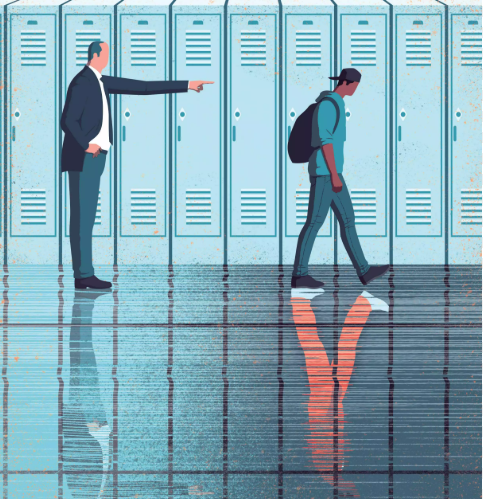
Unreasoning fear has consequences, and the numbers are damning. We all know them. The school-to-prison pipeline has become a machine to send young people on a sometime unalterable course that will impact their lives forever.
In the latest school year for which numbers are available, about 44,100 Oklahoma students, right at 6 percent of the student population, received out of school suspensions. Another 3,350 were expelled out right, cleaved from the very institution designed to help them build a future.
These disciplinary actions are not applied equitably. Students who are male, Black, from communities with fewer economic resources, have disabilities, or identify as LGBTQ+ are disproportionately affected by suspension and expulsion, despite not being significantly more likely to have discipline issues.
Because those who receive suspensions are as much as 59 percent to 64 percent more likely to become justice-involved, these educational disciplinary actions are the opening end of the school-to-prison pipeline.
The “what” is not in question at all. Examining the facts gives us that answer, and the long-term results. More justice-involved individuals, many of whom had that die cast before they were even old enough to know what was happening to them, much less the potential lifelong impact of what was happening to them.
In this piece, let’s examine the “why.” Why can provide a roadmap to solve the larger problem. This writer can examine the “why” from two very different perspectives: as a former elected official from a rural district who prided himself on being a “law and order” official; and, as a justice-involved individual myself.
From that unique vantage point, let us begin with the supposition that it is politics that created the school-to-prison pipeline. The movie The American President was not only a compelling love story between “Sydney Ellen Wade” portrayed by Annette Benning and Michael Douglas’ “President Andrew Shepherd,” like much of screenwriter Aaron Sorkin’s work, it gives us an interesting civics lesson.
When finally going on the offensive against the odious Bob Rumson who is running against him, the fictional President Shepherd explains as simply and eloquently as possible how to win an election. Find an issue, Shepherd said, and then “making you afraid of it, and telling you who’s to blame for it. That, ladies and gentlemen, is how you win elections.”
That one line, a line I used to help teach rhetoric during my time as a schoolteacher in an urban, mostly minority school, is a powerful description of how modern politics works.
The hard-baked racism that exists in our nation, despite all we have accomplished and how far we have come in a short 250 years, creates the environment in which cynical officials can use fear to drive votes on Election Day.
And it even goes beyond racism; it is the ability to create fear of anyone who may be just a tad different. Look at the student populations which are most likely to be disciplined: students of color, or from communities with fewer economic resources, who have disabilities, or who identify as LGBTQ+.
Each of these populations are just a tad different from the stereotypical norm and are often targets of bullying by peers and, sadly, politicians looking to drive voters to the polls. “They are different, be afraid to send your children to school with them. Let’s get them out of the classroom so your good kids can learn,” is the not always subtle message being sent.
So, we as a society send them away from the “good kids,” through the use of out-of-school suspensions, expulsions, or disciplinary alternative education programs with often euphemistic names like “Quest Academy.” Rather than focusing on why a student might have misbehaved, the answer, well-intentioned as it may be, is to get them away from the “good kids.”
his also puts additional pressure on schools, but when we ask schools to do more, we must put more resources into schools. While the cost may seem prohibitive, it will be less in the long run than what the school-to-prison pipeline costs us both in dollars and in human capital.
Make no mistake, the school-to-prison pipeline is a political problem created in the political system. And wherever political problems are created, they can be solved by politics – or more specifically, people standing up for what is right. This is a situation that is the policymaking equivalent of bullying.
Separating children who exhibit discipline issues from other students is the easy answer. To end the school-to-prison pipeline, we must instead do what is hard. Attack the root causes of discipline issues. Find answers to lagging developmental skills; improve the environmental stressors like generational poverty and economic instability; bring an end to inconsistent policy application that creates more significant sanctions against those children who are different.
We must resist the temptation to continue doing the easy thing of making people afraid and then finding the all-too-convenient scapegoat.
There are some things that are more important than votes, such as the life of a child, a life that is often irrevocably changed by a disciplinary action done either in good or bad faith. That is not to say that those who truly present a danger should not be removed from a classroom setting. But we must be absolutely certain of that before we put another soul into the pipeline that all-to-often ends in a prison cell.
This is an issue with so many levels, so it will require a multi-front offensive to correct – and it will not be done overnight, and it won’t be easy. We need supportive, trauma-informed responses over knee-jerk removals from school. We must end the hard-baked systemic racism that continues to hold this nation back from the promise of its founding documents. We need to address the issues of poverty and food insecurity. And, we need to understand that there is no one-size-fits-all answer to every issue relating to school discipline and the feeder into the school-to-prison pipeline.
We have to confront the big issues; we will have to take incremental steps. Because it is a project for the “long game,” it is important we begin soon, and we may never completely finish – always striving like our entire nation for that “more perfect” solution.
But let us begin.
About JAY PAUL GUMM: The Honorable Jay Paul Gumm has been Director of Communications for the Oklahoma Institute for Child Advocacy since November 1, 2018. He is responsible for all external and internal communications projects, including press releases, newsletters, design, and presentation development. He served eight years as a member of the Oklahoma Senate representing Atoka, Bryan, Coal, Johnston, and Marshall counties. There, he developed a reputation for being a passionate advocate for children and the environment. His work for children earned him a place in OICA’s Child Advocate Hall of Fame and recognition by the Oklahoma Court Appointed Special Advocates (CASA) program. Among the legislative awards Gumm received are “Legislator of the Year” by veterans’ organizations, civil rights organizations, real estate advocates, the state’s TRIO student programs, environmental protection organizations, and state employees. Prior to his election to the Senate, he was an award-winning media relations professional, working 13 years for the Oklahoma House of Representatives. Immediately prior to his election, Jay Paul was an economic developer in his hometown of Durant; his work there led to the community becoming the anchor of one of the strongest regional economies in the state. Following his service in the Senate and before beginning work at OICA, Jay Paul was a real estate developer, middle school history/government teacher, and freelance public relations professional, voice actor, and editor. He has more than 35 years of experience in public relations and communication across all media platforms, working for firms in Dallas, Fort Worth, Houston, and Tampa in addition to his work with the Oklahoma House of Representatives. Gumm is a Distinguished Alumnus for his alma mater, Southeastern Oklahoma State University in Durant, OK. Finally, Jay Paul is one of the millions of Americans who is justice-involved.
